
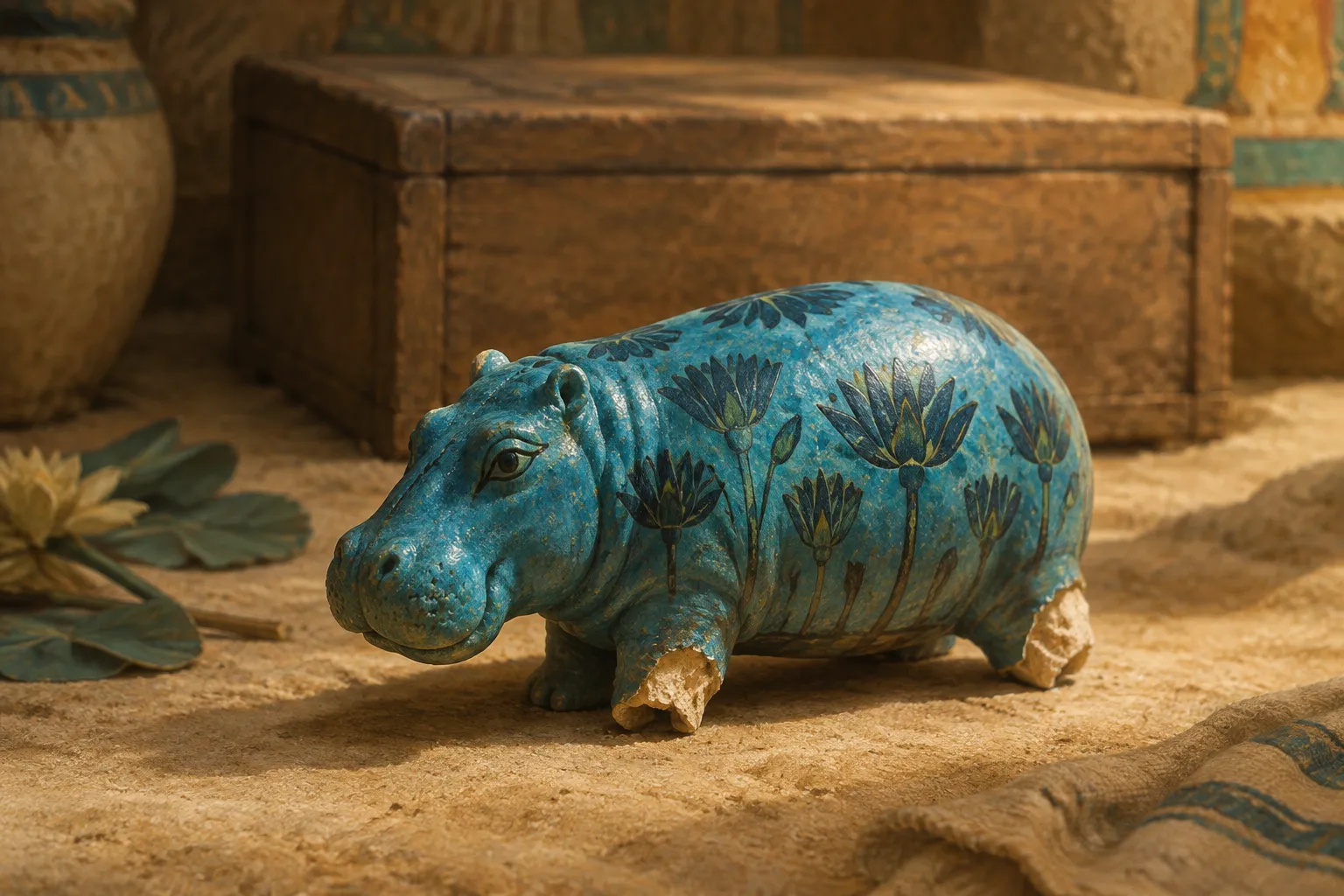
The little blue hippopotamus looks ready to walk. Yet three of the legs visible today are modern restorations. According to the Metropolitan Museum of Art, the ancient legs were probably broken deliberately to stop the creature from harming the dead person it accompanied. The object now nicknamed William makes an unsettling introduction to Egyptian burial religion: something could be valuable enough to place in a tomb, yet dangerous enough to disable first. The museum’s catalogue entry for the figurine preserves that essential qualification: probably.
Why keep the animal at all? The answer is not simply that Egyptians feared hippopotamuses. These figures brought together danger and the hope of renewed life. Breaking a leg could make sense within that combination, rather than contradict it.
A small animal in a particular burial
William belongs to Dynasty 12 of the Middle Kingdom, approximately 1961–1878 BCE. The faience figure measures about 20 centimeters long. It was one of a pair recovered from a shaft associated with the tomb chapel of Senbi II at Meir. The burial equipment also included a coffin, a canopic chest, and models connected with boats and food production. These details come from the Met’s archaeological and object record.
That setting matters. Start with the burial rather than the modern nickname, and the question changes. Instead of asking why someone damaged a charming sculpture, we can ask what place such a creature occupied among preparations for continued existence after death. The surrounding equipment makes that a more useful starting point than treating it as a decorative miniature.
It also keeps the discussion local and historical. This is a Middle Kingdom object from a named burial context, not an illustration of an unchanging Egyptian attitude extending across every century. Its meaning must be approached through its material, its treatment, and the evidence for related figures.
Why invite a hippopotamus into the tomb?
Egyptologist Isabel Stünkel’s study of hippopotami in Egyptian religion explains the positive associations. The animals inhabited the life-giving Nile, and their disappearance beneath the water followed by resurfacing offered an image of regeneration. Faience hippopotamuses are known mainly as grave goods of the Middle Kingdom and Second Intermediate Period.
The interpretation is more interesting than a simple equation between an animal and a single meaning. A creature could suggest renewal through what it did: vanishing and returning, remaining present beneath an apparently empty surface. Read in a burial setting, that pattern offers a way to think about life continuing beyond visible disappearance. This is an explanation of the symbolism, not a surviving account of Senbi’s personal thoughts.
There is an important distinction here between identifying a religious association and reconstructing a complete ceremony. An object can support the first without supplying the second. We should not invent words spoken over the figure, a priest’s gestures, or the precise moment it was placed underground. The surviving evidence does not give us a script.
The flowers make the animal more than an animal
William was molded in faience, a quartz-based ceramic material. Beneath its blue glaze are painted lotuses. The Met interprets these as both the animal’s marsh habitat and symbols of regeneration, connecting their daily opening and closing with renewed life. Its description of the material and decoration therefore treats the flowers as meaningful, not incidental ornament.
Looked at this way, the figure compresses an environment into an animal’s body. The hippopotamus does not stand beside a painted riverbank; it carries the marsh on its surface. That is a visual reading of the design, but it helps explain why removing the flowers from our interpretation would leave an incomplete picture.
The combination also warns against choosing between natural observation and religious meaning. The same decoration can describe a habitat and suggest a hoped-for transformation. Those readings need not compete. For a modern viewer, the useful question is not whether the plants are realistic or symbolic, but how their recognizable character helps the symbolism work.
Breaking a leg without rejecting the figure
A second example makes the problem especially clear. The Rijksmuseum van Oudheden in Leiden holds a faience hippopotamus dated to 2040–1783 BCE. Its discovery place is unknown. The museum identifies a missing piece of one leg as deliberate damage intended to prevent the figure from coming alive and attacking the grave owner. Its record for figurine AED 170 associates the animal with fertility and new life as well as danger.
The two museum explanations suggest a selective intervention: retain the figure, but restrict its capacity to harm. On that reading, the damage did not simply cancel the object. It changed the relationship between the animal image and its intended beneficiary. A broken leg becomes part of the religious interpretation rather than merely a defect to overlook.
However, the Leiden record does not establish a universal rule that every funerary hippo had to lose the same number of legs. Nor should its confident explanation erase the more cautious wording used for William. The safest conclusion is specific: deliberate disabling is a museum-supported interpretation of these examples, not permission to assign every ancient break the same cause.
What these damaged animals let us understand
Stünkel notes that the exact archaeological contexts of most surviving faience hippos are unknown. She also cautions against a neat division between benevolent female and dangerous male hippopotamuses. Egyptian representations do not consistently follow that scheme. These limits are important parts of her assessment of the surviving evidence.
For readers familiar with Egypt’s heart scarab spell, the hippo offers another question about funerary protection: what needed to be controlled so that the dead could benefit? The objects should not be treated as interchangeable, or assumed to have belonged together. The connection is a useful question to carry between them, not proof of an identical ritual.
Above all, the broken hippo asks us to reconsider what a successful religious object should look like. Modern restoration can recover its standing silhouette. Ancient damage, if the interpretation is correct, helped make it safe. Neither condition alone tells the whole story. Its promise lay in the animal’s renewing associations; its broken legs reveal the care with which that promise may have been managed.
Sources and further reading
- Hippopotamus (“William”) — Metropolitan Museum of Art object record, including burial context and restoration.
- Isabel Stünkel, Hippopotami in Ancient Egypt — religious associations, chronology, and interpretive limitations.
- Hippopotamus, AED 170 — Rijksmuseum van Oudheden catalogue entry for a second damaged figurine.