
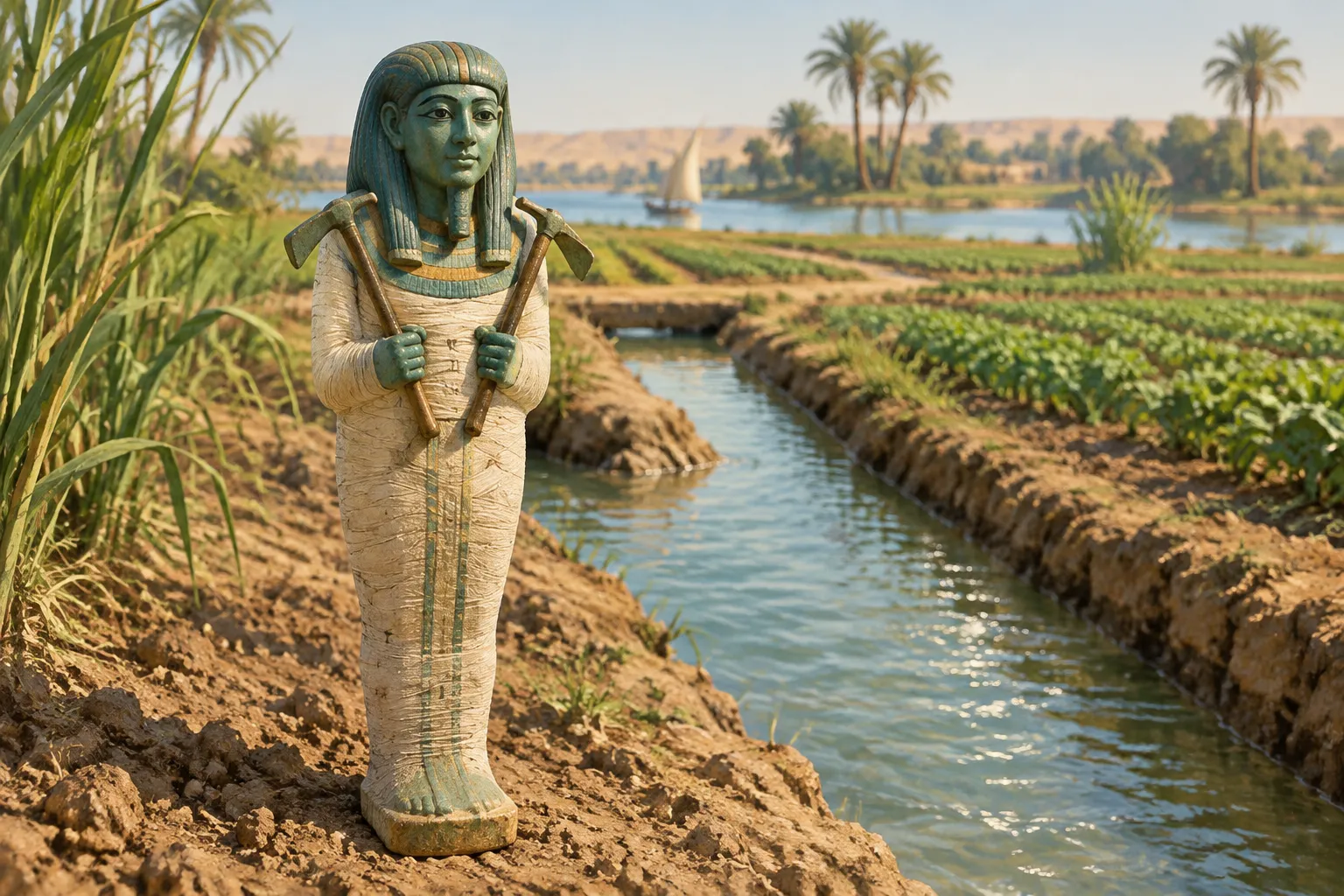
A summons to work was an inconvenience worth preparing for—even after death. In one Egyptian funerary spell, a small figure receives instructions to take its owner’s place when labor is assigned. The tasks are remarkably concrete: cultivation, irrigation, and transporting sand. The solution is equally concrete: someone else must answer. That arrangement is the subject of Spell 6 of the Book of the Dead.
The figure is a shabti. Understanding its assignment changes how we look at these small objects. Rather than treating one simply as a miniature mummy, we can ask a more revealing question: what was it expected to do? The answer brings Egyptian expectations about death into contact with an unexpectedly familiar concern—the next obligation on the work list.
A Spell with a Specific Job
The textual witness considered here is the Papyrus of Nu, from the middle of the Eighteenth Dynasty. In UCL’s translation of this version, the deceased’s summons triggers the shabti’s duty. The figure must present itself for the assignment and announce: “I am doing it – see, I am here”.
The conditional structure matters. This is not a narrative about a servant wandering through the next world. It is an instruction designed for a particular eventuality. If the owner is called, the substitute must respond. Read this way, the spell resembles a carefully prepared answer to a future demand rather than a general description of paradise.
Its practical emphasis also helps establish its limits. This composition addresses work, not every danger or requirement after death. We should not turn its promise into a universal escape from responsibility. Its reader payoff is narrower and more interesting: a funerary object could be given a precisely defined task through an address that specified both the circumstances and the required response.
Before the Book of the Dead
The composition had an earlier history. UCL traces it to Coffin Text 472, attested around 1900–1850 BCE in the Twelfth Dynasty. Later Middle Kingdom evidence includes mummiform figures associated with substitute burials at Lisht and Abydos. The formula subsequently circulated in Book of the Dead manuscripts, continuing into the Ptolemaic Period.
These distinctions prevent a common historical shortcut. The version in Nu’s papyrus is a named witness, not a transcript of what every Egyptian believed throughout antiquity. Likewise, evidence from Lisht and Abydos gives particular places a role in the earlier history; it does not establish that every community adopted the same practice simultaneously.
There is a useful methodological lesson here. A text, a figure, and a burial arrangement are related kinds of evidence, but they are not interchangeable. The text tells us what a substitute might be commanded to do. The object shows how someone supplied a material counterpart. Their combination is especially revealing, provided we keep their dates and contexts visible.
How to Recognize a Worker
Tools offer an important clue. UCL’s overview of shabtis describes figures made in stone, wood, and faience, usually with mummy-shaped bodies and agricultural equipment. Some late Eighteenth Dynasty examples instead wear everyday dress. Crucially, the same overview warns that not every mummiform figure is a shabti: some represented the deceased without this particular working function.
That warning changes the order in which we should examine an object. Shape alone is not enough. A mummy-like outline invites identification, but an inscription, tools, and archaeological context can supply a more persuasive answer. The question is not merely what the figure resembles, but what evidence connects it to substitution.
Even the vocabulary needs care. UCL notes that the name’s original derivation is uncertain, while a later interpretation connected it with answering or responding. It is therefore safer to explain the figure’s function than to build an entire history around a neat English translation of its name. The responding worker is a useful description; an uncomplicated origin story would be less secure.
A Pharaoh Holding Hoes
A striking example belongs to Ramesses VI. The Metropolitan Museum’s faience shabti, dated approximately 1154–1146 BCE in Dynasty 20, measures 28.5 centimeters high. The king wears a nemes headcloth and holds a hoe in each hand. Unlike some agricultural shabtis, this example has no basket on its back.
The juxtaposition is the point: royal identity and field equipment occupy the same figure. As a visual interpretation, we can read this as a refusal to let status alone settle the problem. The substitute is prepared for labor while still visibly representing a king. Its practical assignment does not erase the identity of the person it serves.
The object also carries a caution about ownership. The Met identifies apparently altered cartouches and suggests that an earlier owner may have been Ramesses III. That proposed identification remains qualified. An altered name is evidence of an object’s complicated history, not permission to invent the circumstances or motives behind its reuse.
Looking closely thus rewards us twice: the hoes explain the intended work, while the cartouches complicate any assumption that a funerary object necessarily had one unchanged identity.
From One Substitute to an Organized Workforce
Numbers changed as well. According to UCL’s account of changing burial equipment, elite provisions expanded from a single figure in the Eighteenth Dynasty to much larger groups. A typical Third Intermediate Period arrangement comprised 365 workers and 36 overseers, each overseeing ten. Later sets retained hundreds of figures without the distinctive overseer type.
The scale invites an interpretation of increased organization, but not a claim that every burial contained a complete workforce. An ideal or typical elite arrangement should not become an inventory assigned to all Egyptians. Nor should the later numbers be projected backward onto the papyrus of Nu.
For readers approaching the subject through Osiris and Egyptian hopes for resurrection, shabtis add a different question: not simply whether life could continue, but how its demands might be managed. Their significance lies in that practical turn. The figure does not abolish the assignment. It stands ready to answer it in someone else’s place.
Sources and further reading
- UCL: Book of the Dead Chapter 6—translation from the Papyrus of Nu and the composition’s earlier history.
- The Met: Shabti of Ramesses VI—a royal example with agricultural tools and evidence of altered names.
- UCL: Shabtis—forms, terminology, changing numbers, and identification cautions.