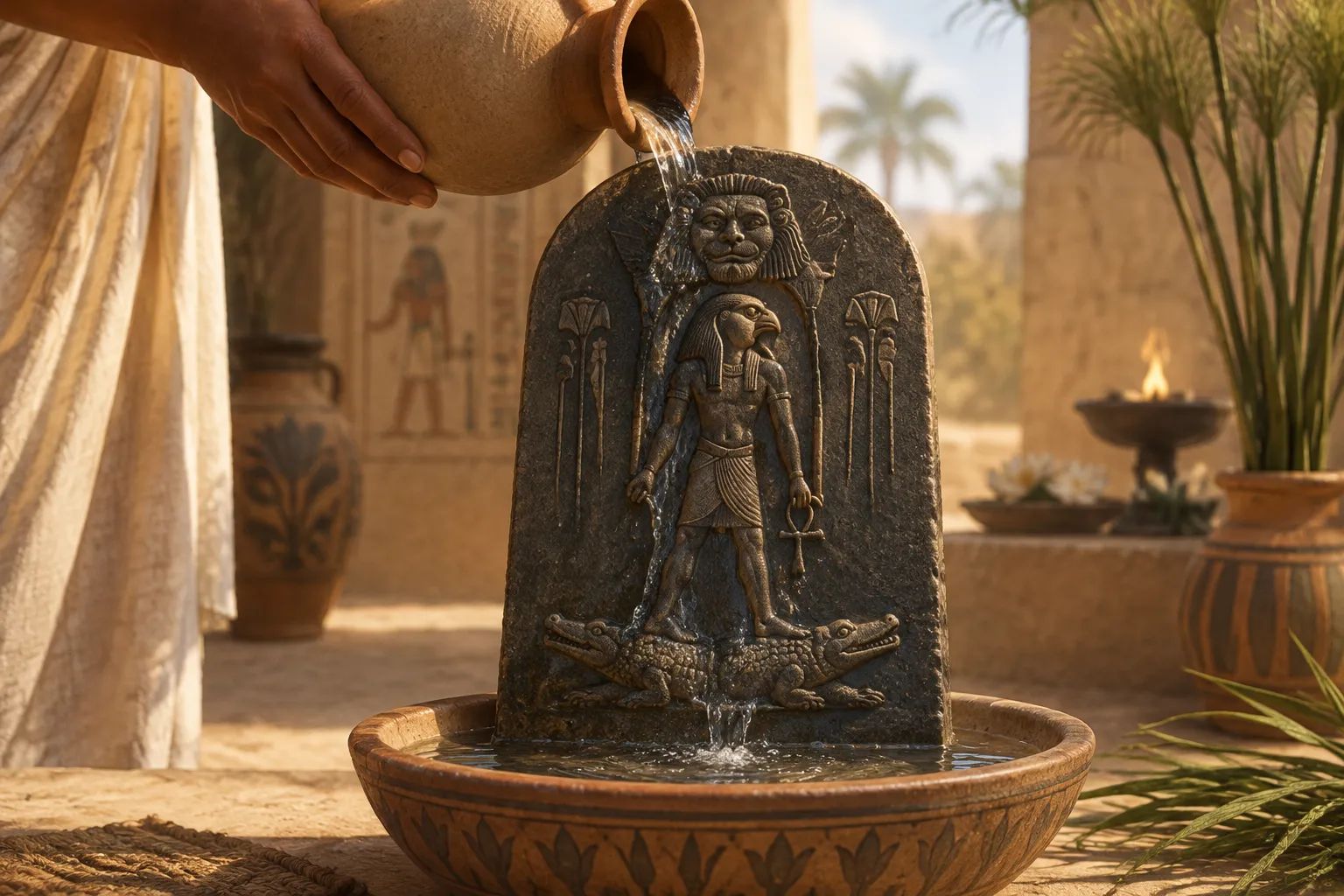
Why pour water over a carved stone instead of simply praying before it? For Egyptians using a Horus healing stela, the water connected a divine victory with a vulnerable human body. According to instructions preserved on some examples, water passed over the monument could become a remedy to drink or apply to the skin. The Metropolitan Museum’s explanation of this practice identifies its particular purpose: relief from snake and scorpion venom.
The act invites us to look differently at the object. A stela was not necessarily a picture to contemplate at a distance. It could be something handled and washed, with its imagery and inscriptions brought into contact with a person seeking protection. Understanding that movement—from stone, through water, to the body—helps explain why a seemingly helpless child occupies the center of such a formidable image.
1. Which Horus stelae are we talking about?
These monuments are commonly called cippi, the plural of cippus, or Horus stelae. UCL’s survey of the object type traces their widespread use from the late Third Intermediate Period through the late Ptolemaic Period. Many were portable amulets; others were larger monuments. Their particular ancient Egyptian name, if they had one, remains unknown.
This was a developing tradition, not a single design unchanged throughout Egyptian history. UCL identifies earlier connections with images of Shed, a youthful protective god whose name means “the saviour.” Some earlier monuments show him in profile rather than presenting the familiar frontal child Horus. The distinction matters: related protective images need not represent identical stages of belief or practice.
A useful question, then, is not “What did every Egyptian do?” but “What does this particular object make possible?” A portable amulet and a substantial monument could share a protective idea while offering different opportunities for carrying, displaying, or washing it. Size is part of the evidence, rather than an incidental detail.
2. Reading the child above the crocodiles
Consider the Met’s chlorite-schist example, object 20.2.23, dated to 332–280 BCE in the early Ptolemaic Period. It comes from Egypt, although the museum record does not identify a specific ancient locality. Just 20.5 centimeters high, it shows youthful Horus standing on two crocodiles, with the protective head of Bes above him. Horus grasps dangerous creatures, including serpents, scorpions, a lion, and an oryx. A sidelock marks his youth.
The museum’s account of the carved animals interprets this arrangement as Horus’s mastery over their dangers. Inscriptions cover every side. Among their concerns are healing, renewal, and the story of Horus recovering after injury.
The striking contrast is between the child’s apparent vulnerability and his complete control. Read as a protective composition, the image does not deny that dangerous animals exist. Instead, it rearranges their relationship to the person at its center: creatures that might attack are held or placed beneath his feet. That is an interpretation of the composition, not a description of an actual encounter.
For readers familiar with the protective bond between Isis and Horus, these objects offer a more narrowly focused question: how could the child’s deliverance become useful to someone outside the divine story?
3. A recovered god as the patient’s model
Giulia Tonon’s University of Liverpool account summarizes the relevant healing narrative: while Isis and her young son were hiding in the marshes, Horus became ill; Thoth assisted Isis and healed him through recitation. The recovered child consequently provided a divine model for protection and recovery.
It is important not to turn that summary into a single definitive version of every Egyptian childhood myth. Nor should we add a dramatic account of the attack where the evidence under discussion does not supply one. The crucial connection here is the movement from affliction to restoration, and the possibility of invoking that movement for another sufferer.
We might describe the underlying appeal this way: the present patient should receive a deliverance comparable to Horus’s. That is a modern explanation, not an ancient quotation. It helps distinguish the stela’s purpose from mere illustration. The story was relevant because its outcome could be sought again.
On this reading, the victorious image and the remembered illness are complementary. The child matters both as someone who needed help and as someone whose recovery could become a promise of help. His vulnerability does not weaken the protective message; it gives the sufferer a point of connection.
4. How water connected monument and body
The Liverpool account describes water poured over larger cippi to acquire the power of their inscriptions and images. Smaller examples could be submerged. The resulting water was consumed in the hope of receiving Horus’s protection. Wear on some amulets also suggests possible rubbing or kissing, although those actions remain interpretations of the physical traces.
This distinction between documented instructions and inferred handling is useful. An instruction tells us what someone prescribed; wear may suggest what someone did. Neither gives us permission to reconstruct every gesture, identify an otherwise unnamed practitioner, or supply words that are not preserved.
Water offers a practical answer to the article’s central question. Stone cannot be swallowed, and a carved narrative cannot literally be placed inside a wound. A liquid can move across a surface and then reach the body. As an interpretation of the ritual’s logic, water made the monument’s promised protection transferable.
That does not mean the carvings were incidental. Without the protective imagery and words, the same movement of water would lack the particular divine connection being sought. The significance lay in contact with this kind of object, not simply in the act of pouring.
5. Healing without a modern divide
UCL cautions against treating these objects as inferior superstition set apart from religion or healing. Their incantations also occur on expensive fourth-century BCE monuments, including the healing statue of Djedher found at Athribis. This was not exclusively a practice of small, inexpensive amulets.
We can take that warning seriously without treating ancient claims of efficacy as demonstrated medical results. Explaining why a person trusted a ritual is different from establishing that it neutralized venom. The evidence discussed here illuminates religious expectations, prescribed actions, and surviving objects—not clinical outcomes.
The most revealing feature of the Horus stela is therefore not an exotic ingredient or a secret formula. It is the attempt to close a distance: between a god’s remembered recovery and an individual’s immediate danger. Pouring water made that connection tangible. The monument could remain in place while something believed to carry its protective force traveled onward to the person who needed it.
Sources and further reading
- The Metropolitan Museum of Art: Magical stela or cippus of Horus — the early Ptolemaic example and its imagery, inscriptions, and use.
- UCL Digital Egypt: Horus stelae — development, terminology, earlier forms, and interpretation.
- Giulia Tonon, University of Liverpool: Horus Cippi — the healing narrative and evidence for ritual handling.


