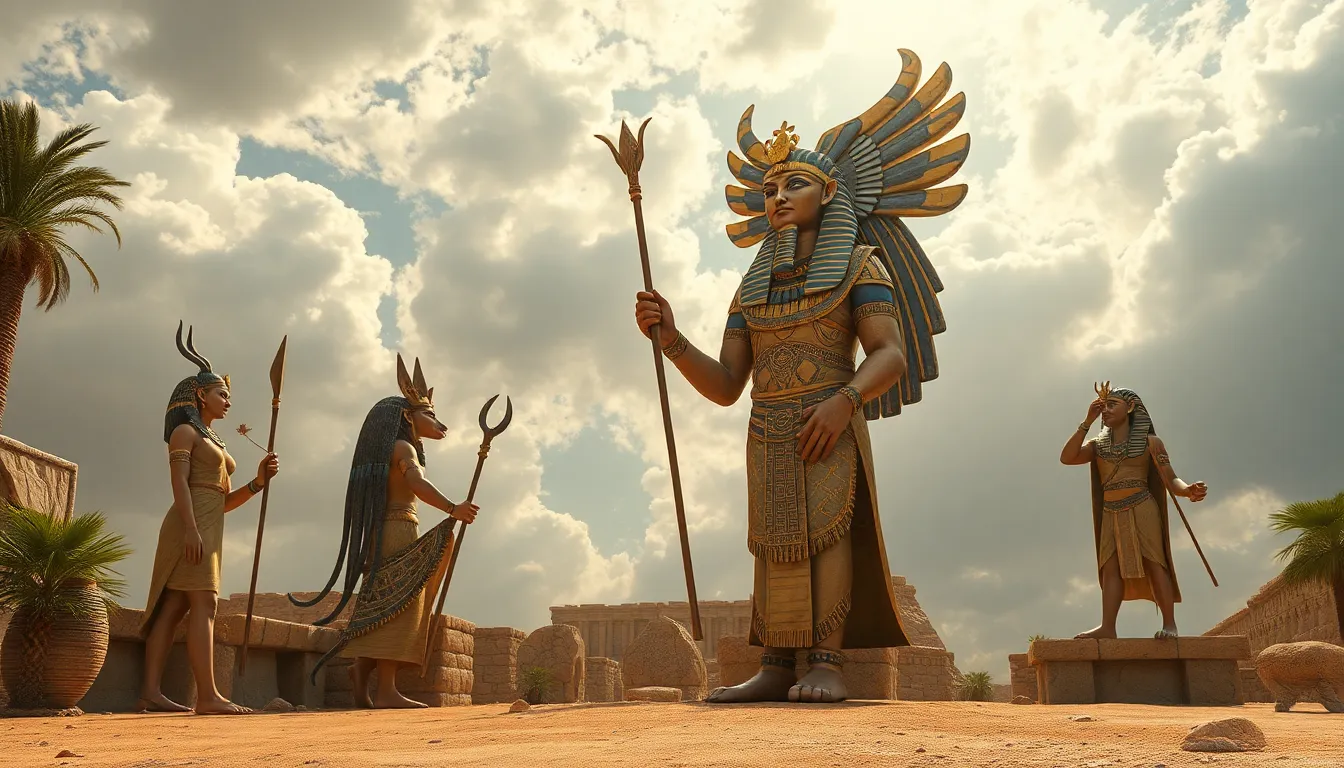
The Story of Nut: The Sky Goddess and Her Legendary Family
I. Introduction
In the vast tapestry of Egyptian mythology, Nut stands as a central figure, revered as the goddess of the sky. Her significance stretches far beyond her celestial domain, embodying the eternal cycle of life, death, and rebirth that was so crucial to the ancient Egyptians. Nut is not only a representation of the night sky but also a mother to some of the most important deities in the Egyptian pantheon. This article delves into her origins, her family, and the myths that surround her, highlighting her enduring legacy in Egyptian culture.
II. Origins of Nut: The Cosmic Creation
Nut’s origins are deeply embedded in the creation myths of ancient Egypt. According to these tales, Nut was born from the primordial chaos, represented by the ocean deity Nun. In these myths, she is often depicted as a cosmic entity who stretches across the heavens, her body forming the arching sky while her husband Geb, the earth god, lies beneath her.
The symbolism of the sky in ancient Egyptian culture is profound. It represented not only the physical realm above but also the spiritual connection to the divine. Nut, as the sky goddess, was seen as a protective force, enveloping the world and safeguarding the stars, which were considered the souls of the deceased.
III. Nut’s Physical Representation
Artistic depictions of Nut are abundant in ancient Egyptian art, showcasing her as a tall, slender figure adorned with stars. She is often illustrated with a blue or dark blue skin tone, symbolizing the night sky. This representation is significant, as it connects her with the cosmos and the infinite expanse of the universe.
- Body as the Sky: Nut’s body is seen as the sky itself, arched over the earth.
- Stars: The stars that adorn her body represent the souls of the departed and the navigation through life.
- Blue Skin: Her blue skin symbolizes fertility and the nurturing aspects of the sky, as well as the life-giving waters of the Nile.
IV. The Family of Nut: Key Deities
Nut’s family is a vital part of her story, comprising some of the most significant deities in Egyptian mythology. Her children—Osiris, Isis, Seth, and Nephthys—each have distinct roles and attributes within the pantheon.
- Osiris: The god of the afterlife, resurrection, and agriculture, Osiris is a symbol of eternal life and regeneration.
- Isis: The goddess of magic and motherhood, Isis is known for her wisdom and protective nature, often depicted as a nurturing figure.
- Seth: The god of chaos and disorder, Seth represents the tumultuous aspects of life and is often in conflict with his brother Osiris.
- Nephthys: The goddess of the night and mourning, Nephthys is associated with the protective aspects of the night, often acting as a guardian.
The dynamics between Nut and her children are complex, filled with love, conflict, and power struggles that reflect the dualities of life itself.
V. Nut and the Cycle of Life
Nut plays a crucial role in the cycles of death and rebirth that define Egyptian cosmology. Each night, she swallows the sun god Ra, only to give birth to him anew each morning. This act symbolizes the perpetual cycle of life, death, and renewal.
Nut’s connection to the sun god Ra is particularly significant, as it underscores her role as a life-giver and protector. The daily journey of Ra across the sky is a metaphor for the journey of the soul, illustrating the belief in an afterlife and the continuity of existence.
The stars and constellations associated with Nut also hold symbolic meaning, representing the souls of the departed, guiding the living, and serving as markers of time.
VI. Myths Involving Nut
One of the most famous myths involving Nut is her forbidden love with Geb, the earth god. Their union was disapproved by Ra, leading to a series of conflicts. To prevent their love, Ra decreed that Nut could not give birth on any day of the year. In a twist of fate, Nut sought the help of Thoth, the god of wisdom, who played a game with the moon, winning enough light to create five additional days. On these days, Nut gave birth to her children, defying Ra’s orders.
This myth illustrates Nut’s power and resilience, as well as the enduring theme of love and defiance against the odds. Additionally, Nut’s conflicts with Ra highlight the intricate relationships within the pantheon, emphasizing the balance between order and chaos.
VII. Worship and Legacy of Nut
Nut was worshipped throughout ancient Egypt, with several temples and sacred sites dedicated to her. The most notable of these is the temple at Dendera, where she was revered as a protective goddess. Rituals associated with her worship often included offerings and prayers for protection and guidance.
Her influence extends beyond ancient times, as Nut continues to resonate in modern culture and spirituality. She is often referenced in discussions about the cosmos, motherhood, and the eternal cycle of life. Her story serves as a reminder of the interconnectedness of existence and the importance of understanding our place within the universe.
VIII. Conclusion
Nut’s significance in Egyptian mythology cannot be overstated. As the sky goddess and mother of key deities, her story provides profound insights into the ancient Egyptian worldview. The dynamics of her family, her role in the cycles of life, and the myths that surround her illustrate the complexity of existence and the enduring themes of love, conflict, and rebirth.
Understanding Nut and her myths enriches our comprehension of ancient Egyptian civilization and its spiritual beliefs. In contemporary contexts, her story serves as a powerful reminder of the timelessness of myth and its ability to connect us to the mysteries of life and the cosmos.