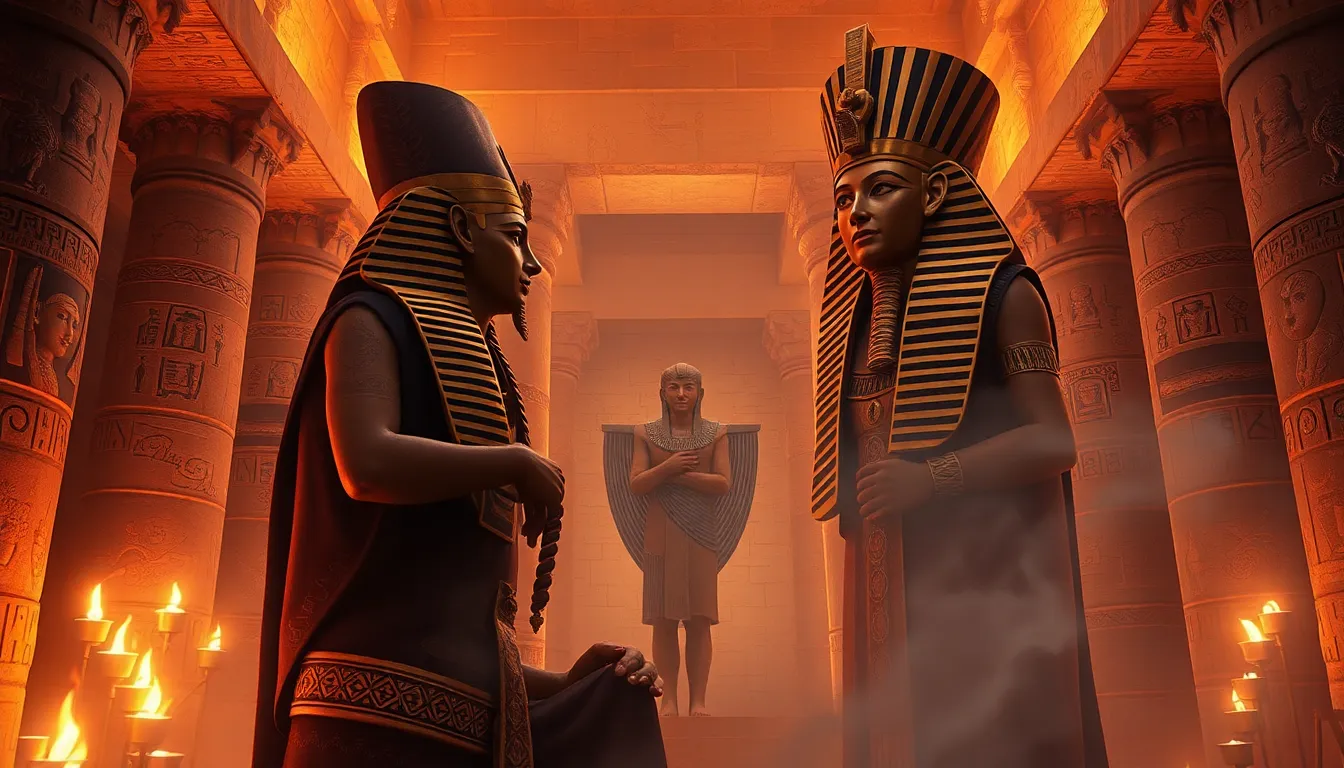
The Sacred Role of the Pharaoh in Temple Rituals
I. Introduction
The Pharaoh of ancient Egypt was not merely a ruler; he was the embodiment of divine authority and the key figure in the religious landscape of the civilization. As both a political leader and a spiritual figure, the Pharaoh held a sacred role that intertwined governance with religion, ensuring the stability and prosperity of the kingdom.
This article aims to explore the significance of the Pharaoh in temple rituals, examining how these ceremonies reinforced the Pharaoh’s position as a mediator between the gods and the people, and how they were critical to the maintenance of Ma’at, the cosmic order central to Egyptian belief.
II. Historical Context of Pharaohs and Religion
The role of the Pharaoh evolved significantly from the early dynasties to the New Kingdom. In the early dynastic period, the Pharaoh was seen primarily as a warrior and a unifier of the people. As religion became more codified, the divine kingship concept emerged, establishing the Pharaoh as a god on earth.
- Early Dynasties: The Pharaoh was a local god, often associated with specific deities.
- Middle Kingdom: The concept of divine kingship became more pronounced, and the Pharaoh was viewed as a protector of Ma’at.
- New Kingdom: The Pharaoh assumed roles in elaborate rituals, enhancing the divine connection with the gods.
Key religious texts, such as the Pyramid Texts and the Coffin Texts, outlined the beliefs surrounding the Pharaoh, emphasizing the importance of the afterlife and the Pharaoh’s role in ensuring the continuation of life beyond death.
III. The Pharaoh as a Mediator Between Gods and Humans
Central to the Pharaoh’s sacred role was the concept of Ma’at, representing truth, balance, and cosmic order. The Pharaoh was perceived as the guarantor of Ma’at, charged with maintaining harmony between the gods and humanity.
Various rituals underscored the Pharaoh’s mediatory function, such as:
- Offering rituals: The Pharaoh presented offerings to the gods in temples, reinforcing his role as a mediator.
- Funerary rites: These rituals highlighted the Pharaoh’s connection to the afterlife, ensuring his continued protection over the land.
The Pharaoh’s divine connection was essential for societal stability, as it was believed that a harmonious relationship between the Pharaoh and the gods directly influenced the prosperity of the nation.
IV. Temple Rituals and the Pharaoh’s Participation
Ancient Egypt featured numerous significant temple rituals, each serving to reinforce the Pharaoh’s divine connection and authority. These rituals were elaborate, often involving the entire populace, and were designed to appease the gods and ensure their favor.
During major ceremonies, the Pharaoh played specific roles, such as:
- Sed Festival: A jubilee celebration that marked the Pharaoh’s reign and renewed his strength.
- Opet Festival: A celebration of fertility and renewal, where the Pharaoh reaffirmed his connection to Amun.
Through symbolic acts performed in the temples, such as offerings, prayers, and processions, the Pharaoh reinforced his role as a divine intermediary, ensuring the blessings of the gods upon his people.
V. The Pharaoh’s Relationship with Priests
The temple hierarchy was complex, featuring a well-developed administration led by priests who managed the rituals and daily operations of the temples. The Pharaoh’s relationship with the priests was crucial in maintaining religious practices.
- Hierarchy: The High Priest ranked closely beneath the Pharaoh, playing a vital role in temple rituals.
- Cooperation: The Pharaoh and priesthood collaborated on religious matters, ensuring that rituals were conducted properly to sustain Ma’at.
- Conflict: Tensions occasionally arose, particularly when a Pharaoh sought to centralize power or alter religious practices.
This intricate relationship between the Pharaoh and the priesthood was fundamental to the functioning of ancient Egyptian religion, where both parties relied on each other to fulfill their roles within society.
VI. Art and Architecture Reflecting the Pharaoh’s Sacred Role
The temples of ancient Egypt serve as monumental reflections of the Pharaoh’s divine authority, designed not only for worship but also as a testament to the Pharaoh’s power. The architecture and art within these sacred spaces encapsulated the essence of the Pharaoh’s role in ritual practices.
- Temples: Structures like Karnak and Luxor were grand in scale, symbolizing the connection between the divine and earthly realms.
- Art and Inscriptions: Walls adorned with reliefs depicted the Pharaoh engaging in rituals, signifying his active participation in maintaining Ma’at.
Case studies of notable temples, such as the Temple of Karnak, highlight how these spaces were designed to facilitate the Pharaoh’s rituals, showcasing his sacred role in the religious life of ancient Egypt.
VII. The Legacy of the Pharaoh’s Ritual Role
The legacy of the Pharaoh’s ritual role extends beyond ancient Egypt, influencing subsequent dynasties and cultures in the region. The rituals established by the Pharaoh set a precedent for the intertwining of religion and governance.
- Subsequent Egyptian Dynasties: Later rulers adopted similar practices, reinforcing the notion of divine kingship.
- Influence on Later Cultures: The concept of a divine ruler spread to neighboring cultures, influencing their governance and religious practices.
- Modern Interpretations: Scholars and enthusiasts continue to explore the significance of the Pharaoh’s role, igniting fascination with ancient rituals.
VIII. Conclusion
The Pharaoh’s sacred responsibilities in temple rituals were paramount to the religious and political fabric of ancient Egyptian civilization. These rituals not only affirmed the Pharaoh’s divine connection but also ensured the stability and prosperity of the kingdom through the maintenance of Ma’at.
Understanding these rituals provides insight into the complexities of ancient Egyptian society, highlighting the enduring significance of the Pharaoh’s legacy as both a ruler and a divine intermediary in the annals of history.