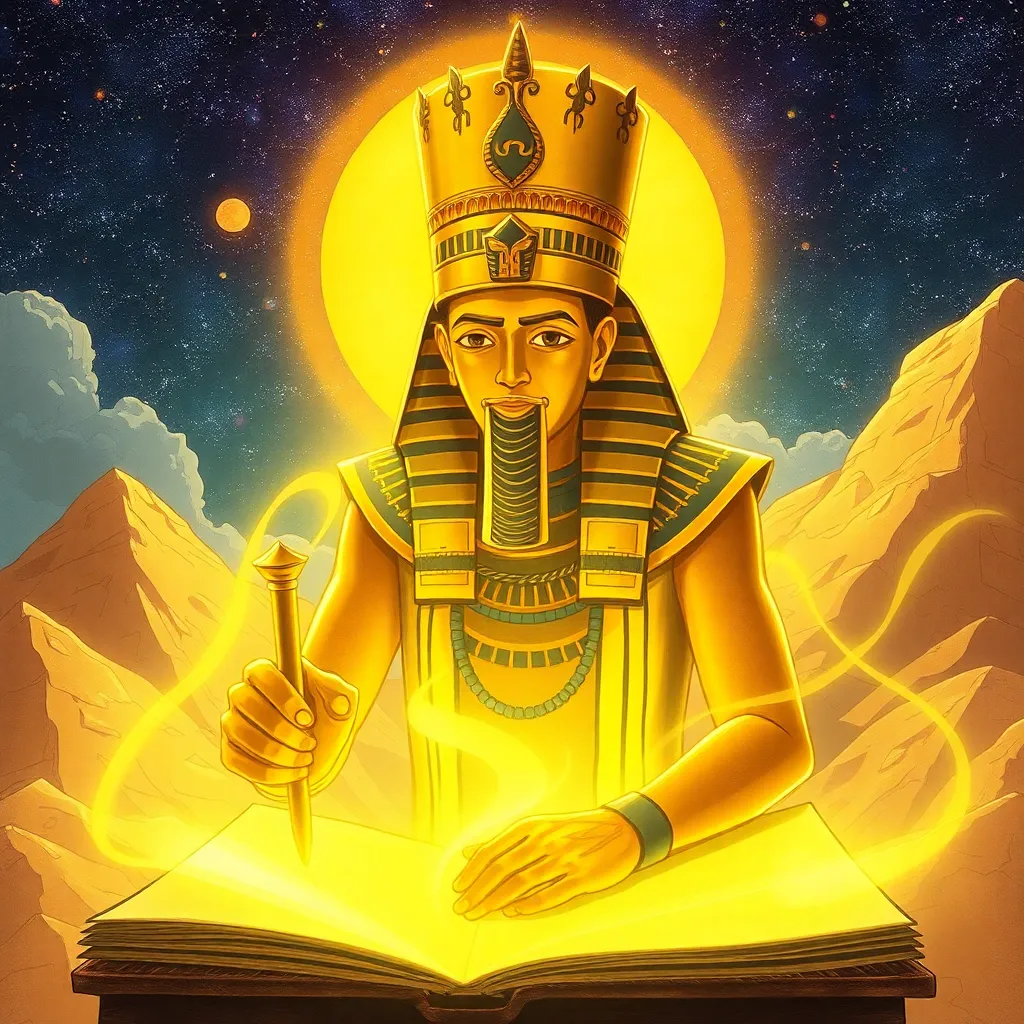
The Role of the God Thoth: Scribe of the Universe
I. Introduction
Thoth, one of the most significant deities in ancient Egyptian mythology, is revered as the god of writing, knowledge, and wisdom. Known as the Scribe of the Universe, Thoth played a crucial role in the maintenance of cosmic order and the recording of human history.
His importance transcends mere symbolism; he is considered a mediator between the divine and mortal realms. This article aims to delve into the multifaceted role of Thoth, exploring his historical context, attributes, contributions to writing and knowledge, and his influence in both ancient and modern cultures.
II. Historical Context of Thoth
A. Origins of Thoth in ancient Egyptian religion
Thoth’s origins can be traced back to the early dynastic period of ancient Egypt. He was commonly associated with the moon, which symbolizes the cycles of time and the recording of events. As a fundamental figure in the Egyptian pantheon, Thoth was believed to have been born from the primordial waters of chaos.
B. Evolution of Thoth’s character over time
Over the centuries, Thoth’s character evolved, reflecting the changing beliefs and practices of ancient Egyptian society. Initially, he was viewed primarily as a lunar deity and later as the god of wisdom, knowledge, and writing. This evolution highlights his adaptability and the significance of knowledge in ancient Egyptian culture.
C. Cultural significance in ancient Egyptian society
Thoth played a vital role in various aspects of Egyptian life, influencing religion, science, and art. His presence was felt in temples, libraries, and schools, where he was venerated as the patron of scribes and scholars. As the god of knowledge, he was integral to the preservation of cultural heritage through writing and documentation.
III. Attributes and Symbols of Thoth
A. Physical representation and iconography
Thoth is often depicted as a man with the head of an ibis or sometimes as a baboon. The ibis, with its long beak, represents his association with writing and wisdom. The baboon symbolizes his role as a keeper of knowledge and a facilitator of communication.
B. Symbols associated with Thoth
- Ibis: Represents wisdom and writing.
- Writing tools: Such as the stylus and palette, symbolize his role as a scribe.
- Moon: Reflects his lunar associations and the passage of time.
C. Attributes reflecting his roles
Thoth embodies several attributes that underscore his significance in Egyptian mythology:
- Wisdom: As the god of knowledge, he is the source of wisdom.
- Writing: He is credited with the invention of hieroglyphics and the art of writing.
- Magic: Thoth is associated with magical practices, particularly in the context of healing and protection.
IV. Thoth as the God of Writing and Knowledge
A. Role in the invention of writing and language
Thoth is often credited with the invention of writing and language, a gift that was crucial for the administration, literature, and preservation of history in ancient Egypt. His contributions laid the foundation for effective communication and record-keeping.
B. Contributions to education and literacy in ancient Egypt
As the patron of scribes, Thoth played a pivotal role in education and literacy. Scribes were highly respected in society, and their skills were essential for governance, trade, and religious practices. Thoth’s influence ensured that knowledge was passed down through generations.
C. Preservation and recording of knowledge
Thoth’s function as a scribe extended to the preservation of knowledge. He was believed to record the deeds of individuals and the laws of the universe, ensuring that history was documented accurately. This role made him indispensable in the religious and administrative spheres of ancient Egypt.
V. Thoth’s Role in the Afterlife and Judgment
A. Involvement in the weighing of the heart ceremony
Thoth played a critical role in the afterlife, particularly in the weighing of the heart ceremony, where a deceased person’s heart was weighed against the feather of Ma’at, the goddess of truth and justice. Thoth served as the scribe who recorded the results of this judgment.
B. Functions as a mediator between gods and humans
As a mediator, Thoth facilitated communication between gods and humans, ensuring that prayers and offerings were conveyed accurately. His wisdom and knowledge made him a trusted intermediary, allowing him to navigate the complexities of divine interactions.
C. Significance in the journey of the soul
Thoth’s significance in the journey of the soul is profound. He not only recorded the outcomes of the judgment but also provided guidance to souls as they navigated the afterlife, helping them to understand the importance of living a just and truthful life.
VI. Thoth in Myths and Legends
A. Notable myths featuring Thoth
Thoth appears in numerous myths, including the story of the creation of the world and in the conflict between Set and Horus. His wisdom often positions him as a key advisor to other deities.
B. His interactions with other deities
- Ra: Thoth assisted Ra in maintaining order in the universe.
- Ma’at: He collaborated with Ma’at to ensure truth and justice prevailed.
- Horus: He played a role in guiding Horus in his struggle against Set.
C. Thoth’s influence on the creation myths
In creation myths, Thoth is often depicted as a key figure who helps shape the world through his knowledge and wisdom. His involvement underscores the belief that knowledge is foundational to existence and order.
VII. Thoth in Modern Culture
A. Representation in contemporary literature and media
Thoth’s character has transcended ancient mythology, appearing in modern literature, films, and games. His representation often emphasizes his qualities as a wise and knowledgeable figure, appealing to themes of knowledge and enlightenment.
B. Influence on modern spirituality and esoteric traditions
Thoth continues to influence modern spiritual practices and esoteric traditions. He is often invoked in rituals and is associated with the pursuit of knowledge and wisdom in various spiritual paths.
C. Thoth’s legacy in the context of global mythology
Thoth’s legacy extends beyond Egyptian mythology, as he has been compared to other mythological figures associated with wisdom and writing, such as Hermes in Greco-Roman traditions. His archetype as a wise scribe resonates with many cultures around the world.
VIII. Conclusion
A. Summary of Thoth’s multifaceted role in mythology
Thoth stands as a multifaceted figure in Egyptian mythology, embodying wisdom, writing, and the intricate balance between order and chaos. His roles as a scribe, mediator, and deity of knowledge highlight his significance in both the mortal and divine realms.
B. Reflection on the relevance of Thoth today
Today, Thoth’s relevance is evident in the continued appreciation for knowledge, writing, and the pursuit of wisdom. His legacy encourages individuals to seek understanding and truth in their own lives.
C. Final thoughts on the importance of preserving ancient wisdom
As we reflect on figures like Thoth, it becomes clear that preserving ancient wisdom is crucial in our modern world. The knowledge and insights from ancient civilizations can guide contemporary thought and foster a deeper understanding of our place in the universe.