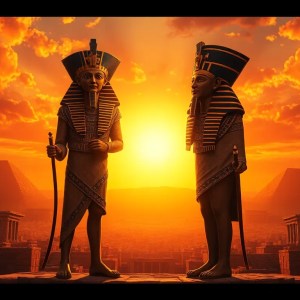
The Myths of Pharaoh Merneptah and the Battle of Kadesh
I. Introduction
Pharaoh Merneptah, the thirteenth son of Ramses II, ruled Egypt from 1213 to 1203 BCE. His reign is often overshadowed by the legacy of his father, but it is marked by significant events, including the famous Battle of Kadesh against the Hittites. This battle is one of the most well-documented conflicts of the ancient world, yet it is surrounded by numerous myths and misconceptions. In this article, we aim to debunk some of these myths, providing a clearer understanding of Merneptah and the Battle of Kadesh.
II. Historical Context of the Battle of Kadesh
The Battle of Kadesh, fought around 1274 BCE, was a defining moment in the long-standing conflict between Egypt and the Hittite Empire. The backdrop of this struggle was a complex interplay of territorial ambitions, trade routes, and power dynamics in the ancient Near East.
Key figures in this conflict include:
- Ramses II: Merneptah’s father, known for his military campaigns and monumental architecture.
- Merneptah: The successor of Ramses II, who inherited a kingdom with ongoing conflicts.
- Hattusili III: The Hittite king during the battle, who sought to expand his influence over the region.
Kadesh held strategic importance due to its position along vital trade routes and its role as a cultural crossroads. Control over Kadesh meant control over trade and military routes, making the battle pivotal for both Egypt and the Hittites.
III. The Myth of Merneptah as a Warrior Pharaoh
Many people perceive Merneptah as a formidable warrior due to his father’s legacy. However, this perception is often exaggerated. While Merneptah did engage in military campaigns, his portrayal as a dominant warrior is not as pronounced as that of Ramses II.
Some points to consider include:
- Merneptah’s military achievements were relatively modest compared to Ramses II’s extensive campaigns.
- Historical texts often emphasize Ramses II’s victories and prowess, overshadowing Merneptah’s contributions.
- Archaeological evidence suggests that Merneptah may have focused more on internal stability than on military conquest.
Therefore, while Merneptah was a ruler during times of conflict, his image as a warrior pharaoh is more a reflection of his father’s legacy than of his own military exploits.
IV. Misconceptions About the Battle’s Outcome
Traditionally, narratives of the Battle of Kadesh portray Merneptah as emerging victorious. However, a closer examination reveals a more complex situation.
Key misconceptions include:
- The belief that Merneptah decisively defeated the Hittites at Kadesh.
- The idea that his military leadership was instrumental in achieving a clear victory.
In reality, the battle resulted in a stalemate, with both sides claiming victory. Propaganda played a significant role in shaping these narratives, as both Egyptian and Hittite accounts sought to enhance their respective leaders’ images. Thus, the portrayal of Merneptah’s victory is as much about political rhetoric as it is about historical fact.
V. The Role of the Merneptah Stele
The Merneptah Stele, inscribed around 1208 BCE, is one of the most significant artifacts from Merneptah’s reign. It commemorates his military victories and serves as an important historical document.
Significance of the Merneptah Stele includes:
- It is one of the earliest references to Israel outside the Bible, indicating the extent of Merneptah’s campaigns.
- The stele contains inscriptions celebrating Merneptah’s triumphs, but it has also led to myths regarding the specificity of his victories.
- Historians interpret the stele as both a record of achievements and a tool for political propaganda.
Understanding the context and content of the Merneptah Stele is essential for interpreting the true nature of Merneptah’s military successes and the Battle of Kadesh.
VI. The Impact of the Battle on Egyptian Politics
The Battle of Kadesh had lasting effects on Egyptian politics during Merneptah’s reign. The outcome influenced not only his rule but also the broader context of Egypt’s military and diplomatic relations.
Considerations include:
- The battle’s aftermath prompted Merneptah to focus on consolidating power within Egypt rather than pursuing further military campaigns.
- Relations between Egypt and the Hittite Empire became more complex, leading to eventual peace treaties.
- Merneptah’s rule is often characterized by a blend of military posturing and diplomatic engagement.
Thus, the Battle of Kadesh significantly shaped the trajectory of Merneptah’s reign and the political landscape of the region.
VII. Legacy of Merneptah and the Battle of Kadesh
Merneptah’s legacy is intertwined with the Battle of Kadesh and how it has been depicted in history and culture. While often overshadowed by his father’s grandeur, his contributions remain significant.
Aspects of his legacy include:
- Merneptah is remembered for his efforts to maintain stability within Egypt during a tumultuous period.
- The Battle of Kadesh has been depicted in later Egyptian art, often emphasizing victory and military prowess.
- Modern interpretations of Merneptah’s reign and the battle continue to evolve, influencing how we understand ancient Egyptian history.
Merneptah’s legacy serves as a reminder of the complexities of leadership and the narratives that define historical figures.
VIII. Conclusion
In summary, the myths surrounding Pharaoh Merneptah and the Battle of Kadesh reveal much about the interplay of history and propaganda. By examining the historical context, reevaluating perceptions of Merneptah as a warrior, and understanding the outcomes of the battle, we gain a clearer picture of this fascinating period in ancient Egyptian history.
The importance of historical accuracy cannot be overstated, as it allows us to appreciate the nuances of ancient figures and events. Continued research and exploration of ancient Egyptian history will further illuminate the legacies of rulers like Merneptah and the true nature of their conflicts.