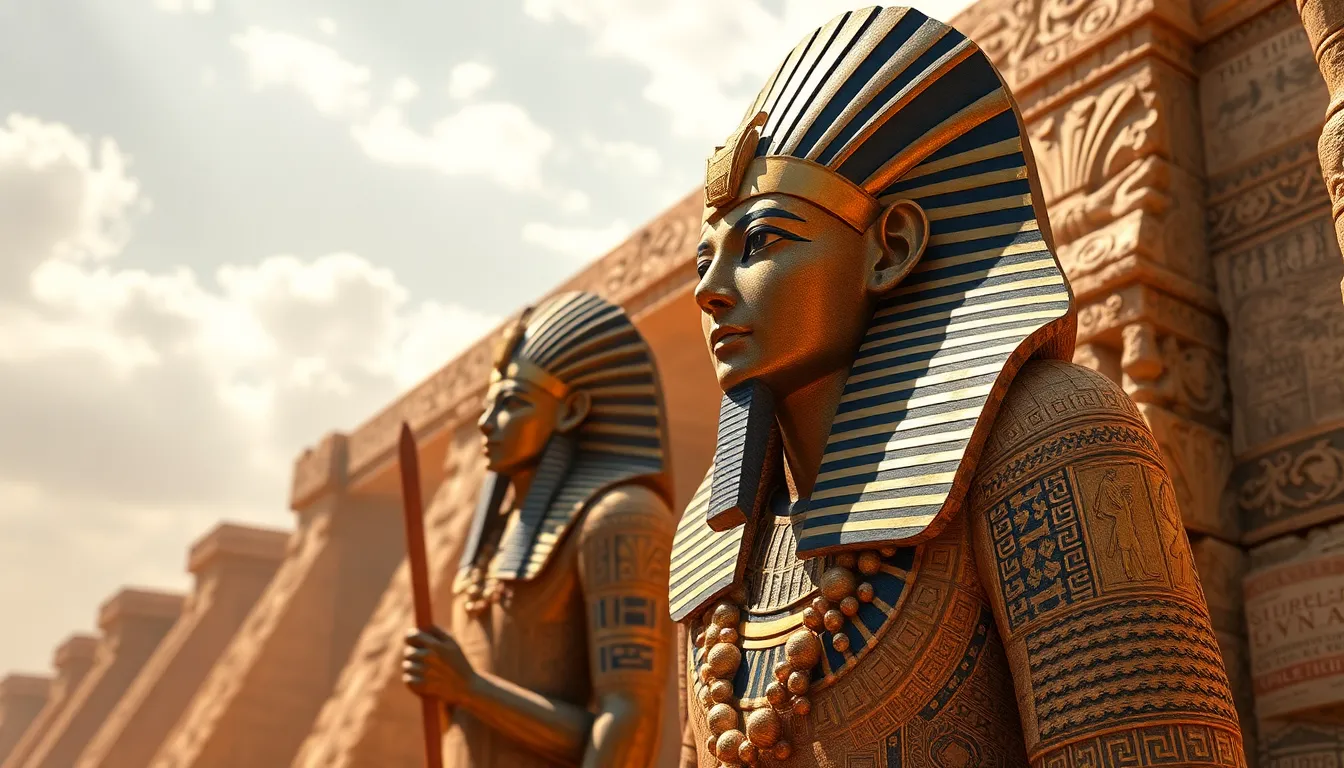
The Myths of Pharaoh Akhenaten’s Rebellion Against Tradition
I. Introduction
Pharaoh Akhenaten, one of ancient Egypt’s most controversial rulers, reigned during the 18th Dynasty, a period known for its remarkable achievements in art, architecture, and religion. His reign, from approximately 1353 to 1336 BCE, marked a significant departure from traditional Egyptian beliefs and practices, leading to a myriad of myths and misconceptions about his rule. This article aims to debunk some of the most prevalent myths surrounding Akhenaten’s rebellion against tradition and to provide a clearer understanding of his impact on Egyptian society.
II. The Historical Context of Akhenaten’s Rule
A. Brief biography of Akhenaten
Originally named Amenhotep IV, Akhenaten ascended to the throne as the son of Amenhotep III. Early in his reign, he embraced the worship of Aten, the sun disc, and ultimately changed his name to Akhenaten, meaning “Effective for Aten.” This shift marked the beginning of his radical religious reforms and his movement away from the worship of the traditional pantheon of Egyptian gods.
B. Overview of the 18th Dynasty and its religious landscape
The 18th Dynasty was a time of great power and prosperity for Egypt, characterized by a polytheistic belief system deeply embedded in the culture. The worship of gods such as Amun, Osiris, and Isis was prevalent, with elaborate temples and a strong priestly class overseeing religious practices. Akhenaten’s reign disrupted this long-standing tradition, introducing a unique form of worship that centered on a single deity.
C. Introduction of the Aten worship and its significance
Aten worship is significant as it represented a shift from the established religious order. Akhenaten promoted Aten as the sole god, which not only challenged the existing religious hierarchy but also transformed the role of the pharaoh in Egyptian society. His pursuit of a new religious ideology was both revolutionary and controversial.
III. Myth 1: Akhenaten Was the First Monotheist
A. Examination of the concept of monotheism in ancient Egypt
While Akhenaten is often hailed as the first monotheist, this claim requires scrutiny. Ancient Egypt was characterized by a form of polytheism, where multiple gods were worshipped simultaneously. Monotheism, as understood in contemporary terms, did not exist in the same way during Akhenaten’s time.
B. Comparison with previous and contemporary religious practices
Previous Pharaohs venerated various gods, often elevating one deity over others without completely dismissing the pantheon. For instance, Pharaoh Amenhotep III honored Amun while still acknowledging other gods. Akhenaten’s focus on Aten can be seen as an extreme form of henotheism rather than true monotheism.
C. Analysis of Akhenaten’s Aten worship in the context of polytheism
Akhenaten’s Aten worship did not completely deny the existence of other gods; rather, it marginalized them. Evidence suggests that the worship of other deities continued, albeit at a reduced scale. Akhenaten’s reforms were not a complete rejection of polytheism but rather an attempt to elevate Aten above all others.
IV. Myth 2: Akhenaten Completely Abolished Traditional Religions
A. Evidence of continued worship of other deities during his reign
Despite Akhenaten’s promotion of Aten, worship of traditional gods persisted. Archaeological findings indicate that temples dedicated to other deities remained active during his rule, and inscriptions suggest that people continued to pray to gods like Amun.
B. The role of the priesthood and temples in society
The priesthood played a crucial role in maintaining the religious fabric of society. While Akhenaten attempted to diminish their power, the priests of traditional gods still held sway over the populace, illustrating that the old religious structures were not entirely dismantled.
C. Discussion of Akhenaten’s religious reforms and their limitations
Akhenaten’s reforms were radical yet limited in their reach. The construction of the new capital, Akhetaten (modern-day Amarna), was a significant step in promoting Aten worship, but this did not equate to the eradication of traditional practices across Egypt.
V. Myth 3: Akhenaten’s Reforms Were Universally Rejected
A. Examination of the reactions from the elite and common people
While Akhenaten faced significant opposition from various segments of society, including the powerful priesthood, there is evidence that some segments of the elite and common people supported his reforms. The extent of this support, however, remains a subject of debate among historians.
B. Evidence of both support and opposition to Akhenaten’s policies
Archaeological evidence shows that there were supporters of Aten worship, and some artistic depictions from the time reflect a level of acceptance of Akhenaten’s new religious order. However, this was countered by significant resistance, particularly from the priestly class of Amun.
C. Historical interpretations of the aftermath of his reign
The aftermath of Akhenaten’s reign saw a swift return to traditional practices, suggesting that while his reforms were controversial, they were not entirely rejected during his lifetime. Historical interpretations vary, with some arguing that his ideas influenced future rulers, albeit indirectly.
VI. Myth 4: Akhenaten Was an Isolated Figure
A. Exploration of his relationships with other leaders and cultures
Contrary to the notion of Akhenaten as an isolated figure, he maintained diplomatic relationships with neighboring states. Letters from the Amarna Period reveal correspondence with other leaders, indicating that he was aware of and engaged with regional politics.
B. Influence of Akhenaten’s ideas on subsequent rulers
Akhenaten’s ideas did not vanish with his death; rather, they influenced future generations of rulers. The brief return to traditional worship under Tutankhamun and subsequent pharaohs reflected a complex legacy that acknowledged Akhenaten’s impact.
C. The legacy of Akhenaten in the context of Egyptian history
Akhenaten’s legacy is multifaceted. While his religious reforms were largely rolled back, his reign is often viewed as a precursor to later religious transformations within Egypt, and his artistic innovations left an indelible mark on Egyptian art and culture.
VII. The Impact of Akhenaten’s Reign on Future Generations
A. Discussion of how Akhenaten’s rule influenced later pharaohs
Later pharaohs, particularly those during the 19th Dynasty, grappled with the implications of Akhenaten’s rule. His radical shift in worship and the subsequent rejection of his ideas created a context for the reaffirmation of traditional beliefs.
B. The long-term effects of his religious reforms on Egyptian society
Akhenaten’s religious reforms introduced a new way of thinking about divinity that, while not fully embraced, sparked discussions that influenced the spiritual landscape of Egypt in subsequent eras.
C. Reassessment of Akhenaten’s legacy in modern times
Modern scholarship continues to reassess Akhenaten’s legacy, exploring the nuances of his reign and the complexities of his religious reforms. His story remains relevant, reflecting broader themes of change, resistance, and the interplay of culture and religion.
VIII. Conclusion
This exploration of the myths surrounding Pharaoh Akhenaten reveals a ruler whose impact on Egyptian history is both profound and complex. By analyzing common misconceptions, we gain a better understanding of his reign and its significance in the broader tapestry of ancient Egyptian civilization. Akhenaten’s story is not merely one of rebellion against tradition but also one of innovation and the enduring struggle between established norms and new ideas, a theme that resonates throughout history and continues to be relevant today.