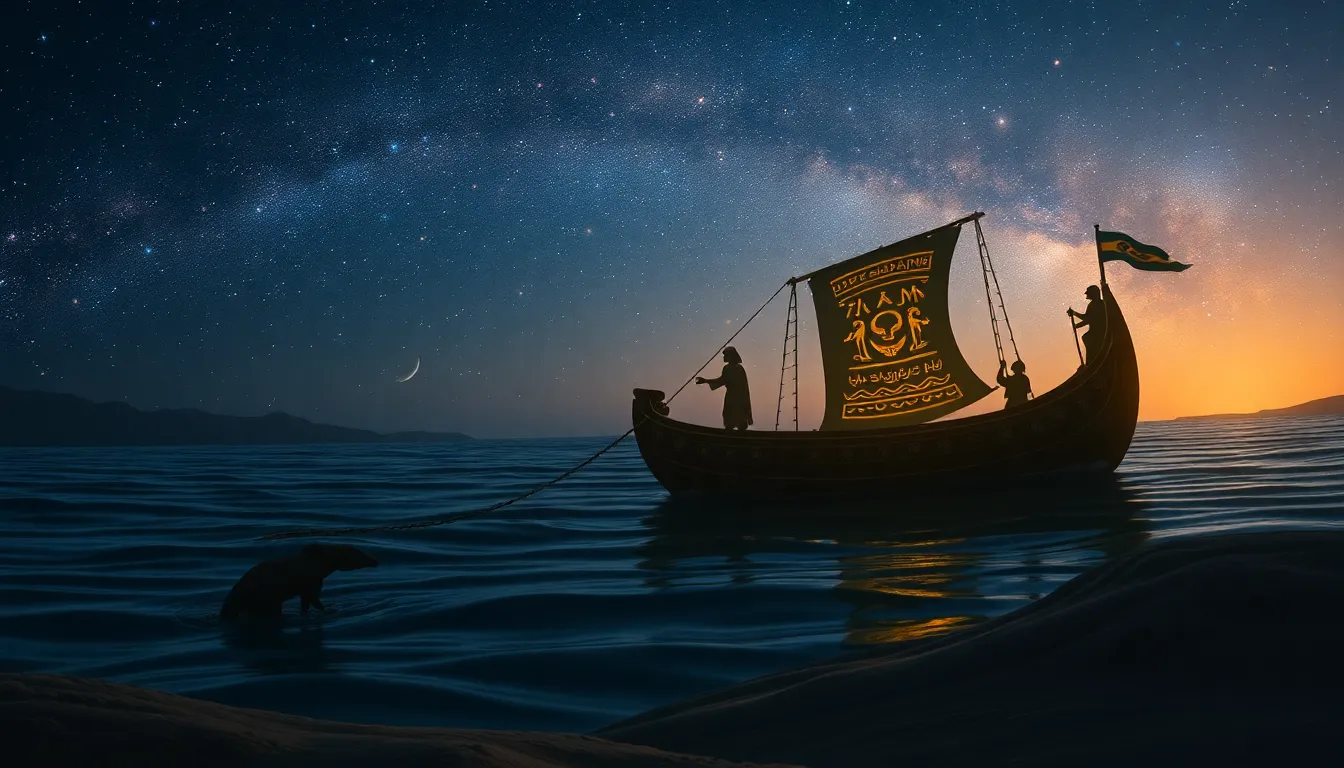
The Myth of the Starry Boat: Ra’s Journey through the Night Sky
I. Introduction
The myth of Ra, the ancient Egyptian sun god, is a cornerstone of Egyptian mythology, encapsulating the civilization’s understanding of life, death, and the cosmos. As the embodiment of the sun, Ra’s significance transcended mere illumination; he was a symbol of creation, order, and the cyclical nature of existence. Central to his mythos is the journey he undertakes every day, navigating the vast sky and plunging into the underworld at night, represented by his celestial vessel, the starry boat.
The night sky held profound significance for ancient cultures, serving not only as a navigational aid but also as a canvas for their myths and beliefs. Stars were not mere points of light; they were the souls of the departed, gods, and markers of time. This article aims to delve into Ra’s journey through the night sky, exploring the symbolic meanings embedded in this ancient narrative.
II. The Creation of the Starry Boat
Ra’s celestial vessel, often referred to as the “barque of millions of years,” is described in ancient texts as a magnificent boat that glides across the heavens. It is said to be adorned with gold and precious stones, reflecting the brilliance of the sun.
The symbolism of the boat in ancient Egyptian cosmology is profound. It represents:
- The journey of life and death
- The cyclical nature of time
- The connection between the earthly realm and the divine
Various deities played a role in the creation of Ra’s boat. For instance, the goddess Neith is often credited with weaving the boat, symbolizing the intertwining of fate and destiny. Additionally, the materials used to construct the starry boat were believed to be imbued with divine powers, further enhancing its significance in the nightly journey.
III. Ra’s Daily Journey
During the day, Ra traverses the sky in his boat, lighting the world and nurturing life. His path is a majestic arc, representing the journey of the sun from dawn, through the zenith, and back to dusk.
The role of the sun in sustaining life on Earth is paramount. It provides warmth, light, and energy, essential for agriculture and the rhythm of daily life. As dusk approaches, the transition from day to night carries significant weight, symbolizing the end of one cycle and the beginning of another.
IV. The Nighttime Voyage
As the sun sets, Ra’s journey takes a dramatic turn as he descends into the underworld, known as Duat. This realm is depicted as a dark, challenging landscape filled with obstacles and creatures that test Ra’s strength and resolve.
Throughout the night, Ra faces numerous challenges and adversaries, including:
- Apophis (Apep), the serpent of chaos who seeks to devour Ra
- Various demons and spirits that inhabit the Duat
Despite these challenges, Ra is accompanied by a host of deities and mythical creatures, including the protective goddess Ma’at, who represents truth and order. Together, they navigate the darkness, ensuring that the sun will rise again.
V. Symbolism and Interpretations
The journey of Ra in the starry boat is rich with symbolism, particularly concerning rebirth and renewal. Each night, as Ra travels through the underworld, he symbolizes the cycle of life, death, and rebirth. This journey illustrates the belief that life continues beyond death, a core tenet of ancient Egyptian spirituality.
The duality of light and darkness is also central to Ra’s journey. His passage through the night reflects the balance between joy and sorrow, knowledge and ignorance, life and death. This duality can be interpreted in various ways, mirroring the human experience of facing challenges and overcoming them.
VI. Cultural Impact and Legacy
The myth of Ra has had a profound influence on ancient Egyptian society, shaping their religious practices, art, and worldview. Ra was worshipped as the ruler of the sky, and pharaohs often aligned themselves with him to validate their divine right to rule.
Artistic representations of Ra and his starry boat are found in numerous ancient artifacts, including:
- Reliefs in temples
- Funerary texts and tomb paintings
- Statues and amulets
In contemporary culture, the myth of Ra continues to inspire literature, art, and spiritual practices, serving as a reminder of the enduring power of myths in understanding human existence.
VII. Comparative Myths
Ra’s journey through the night sky shares similarities with celestial myths from other cultures. For instance:
- In Greek mythology, Helios, the sun god, drives his chariot across the sky, facing challenges along the way.
- Norse mythology features the sun goddess Sól, who is chased by the wolf Sköll, symbolizing the struggle between light and darkness.
These myths encapsulate universal themes of journeys, challenges, and rebirth, highlighting the shared human experience across cultures. Ra’s story enriches the tapestry of global mythology, reminding us of the commonalities in our quest for understanding the cosmos.
VIII. Conclusion
In conclusion, Ra’s journey through the night sky in his starry boat serves as a powerful metaphor for the cycles of life, death, and rebirth. This myth encapsulates the ancient Egyptians’ understanding of their world and their place within it, reflecting the enduring significance of celestial navigation and the mysteries of the universe.
The legacy of Ra and the starry boat continues to resonate in contemporary culture, illustrating the timeless nature of myths in exploring human existence and the cosmos. Through Ra’s journey, we gain insight into the complexities of life and the eternal dance between light and darkness.