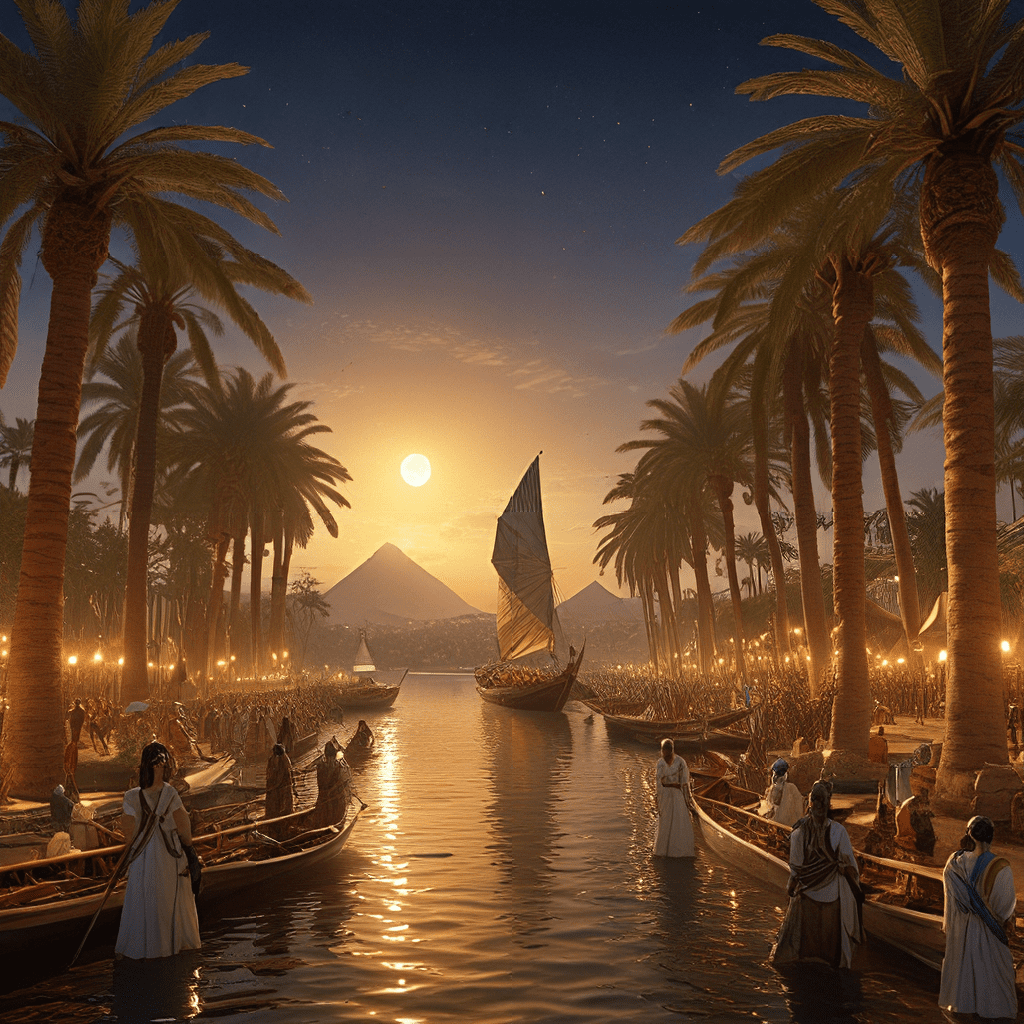
The Opet Festival: A Coronation of the Nile
1. Introduction: The Nile – Lifeblood of Egypt
The Nile River was the very heart of ancient Egyptian civilization. More than just a waterway, it was the source of life itself. Its annual flooding brought rich, fertile soil to the land, allowing for bountiful harvests that sustained the people. The Nile was a symbol of abundance, prosperity, and renewal, deeply interwoven with the fabric of Egyptian life.
2. The Opet Festival: A Celebration of Renewal
The Opet Festival, celebrated annually in ancient Egypt, was a grand celebration of the Nile’s life-giving power. The festival’s name, “Opet,” is believed to have originated from the ancient Egyptian word for “the inundation,” referring to the Nile’s annual flooding. With each flood, the river brought new life to the land, refreshing the soil and ensuring continued prosperity. This cycle of rebirth mirrored the cycle of life, death, and renewal that the Egyptians saw as fundamental to the universe.
Beyond simply celebrating the Nile’s bounty, the Opet Festival was also deeply connected to the pharaoh’s power and legitimacy. The pharaoh, considered the divine king, was seen as the embodiment of Horus, the god of kingship, and the son of Ra, the sun god. The festival provided a powerful ritualistic framework to reinforce the pharaoh’s connection to the divine, ensuring his rule was seen as both legitimate and divinely sanctioned.
3. The Divine Processions: A Spectacle of Gods and Pharaohs
The centerpiece of the Opet Festival was a series of grand processions that involved the pharaoh, priests, and sacred statues. The most important statues were those of Amun-Re, Mut, and Khonsu, the divine triad of Thebes, a major city in ancient Egypt. Amun-Re, the king of the gods, was associated with the Nile’s creative power, making him a central figure in the festival. Mut was his wife, the goddess of motherhood, and Khonsu was their son, the lunar god.
The processions were elaborate spectacles. The statues of the gods were carried on ornate barges, adorned with beautiful decorations and precious materials. Priests and officials would walk alongside, chanting hymns and performing rituals. The pharaoh himself would be present, often wearing a magnificent headdress and holding a scepter, symbolizing his divine authority. The sight of the pharaoh and the gods moving together in procession was a powerful display of the connection between the earthly and divine realms, showcasing the pharaoh’s role as a divine king.
4. The Journey to Luxor: A Sacred Pilgrimage
The procession began at the Karnak Temple, a vast temple complex dedicated to Amun-Re. From there, the procession embarked on a sacred journey to Luxor Temple, another important temple complex located on the opposite bank of the Nile. This journey was not just a physical one but also a symbolic pilgrimage, reflecting the connection between the pharaoh and the gods. It was believed that the pharaoh, by joining the gods in this journey, was symbolically merging with their divine power.
The procession route itself was carefully chosen. It passed through the heart of Thebes, along the Nile’s banks, emphasizing the connection between the divine, the pharaoh, and the life-giving river. The journey was a public spectacle, with ordinary people lining the streets to witness the procession and pay homage to the pharaoh and the gods. It was a moment for the community to come together and celebrate the annual renewal brought by the Nile and to reaffirm their allegiance to their divine king.
5. The Rituals at Luxor Temple: A Symbolic Reinstatement
Upon reaching Luxor Temple, the procession culminated in a series of elaborate rituals. These rituals were performed inside the temple, in the presence of the pharaoh and the priests. Offerings of food, wine, and incense were presented to the gods, and prayers were recited to ensure their favor. The pharaoh would actively participate in these rituals, demonstrating his connection to the divine and his role as mediator between the gods and the people.
These rituals held profound symbolic meaning. They were understood as a symbolic re-enactment of the pharaoh’s assumption of power and his continued connection to the gods. During the festival, the pharaoh was seen to temporarily “die” and be “reborn” through the rituals. This symbolic death and rebirth mirrored the cycle of the Nile’s flooding and the renewal it brought. The festival became a reminder of the pharaoh’s divine mandate and his role as the embodiment of the Nile’s life-giving power.
6. The Role of Amun-Re: The Divine King
Amun-Re was central to the Opet Festival, representing the ultimate source of power and life. As the supreme god, he was seen as the creator of the universe and the source of the Nile’s annual flooding. His power was associated with the sun’s life-giving energy, which in turn fueled the Nile’s fertility. Therefore, Amun-Re, the king of the gods, mirrored the pharaoh, the king of Egypt, in his role as a divine ruler.
The festival was a time when the pharaoh was closely associated with Amun-Re. During the processions, the pharaoh would carry the statue of Amun-Re on his shoulders, symbolically embodying the god’s power. Through these rituals, the pharaoh demonstrated his connection to the god, reinforcing his legitimacy and divine authority. The pharaoh was not just a ruler; he was considered a manifestation of the divine, a living embodiment of Amun-Re’s power and authority.
7. The Pharaoh’s Symbolic Rebirth: A New Reign Begins
One of the most striking aspects of the Opet Festival was the symbolic “death” and “rebirth” of the pharaoh. This ritual, woven into the fabric of the festival’s ceremonies, showcased the connection between the Nile’s cycle of life and the pharaoh’s reign. With each flood, the Nile brought new life and prosperity, and with each Opet Festival, the pharaoh was symbolically reborn, reinvigorated, and renewed.
This symbolic death and rebirth was not a literal one but a powerful metaphor. The pharaoh, through the rituals, was symbolically cleansed of the burdens of his reign and reconnected to the divine source of his power. This act of symbolic renewal was crucial for maintaining the pharaoh’s authority and legitimacy. It showed the people that their king was still connected to the divine and therefore, still worthy of their allegiance.