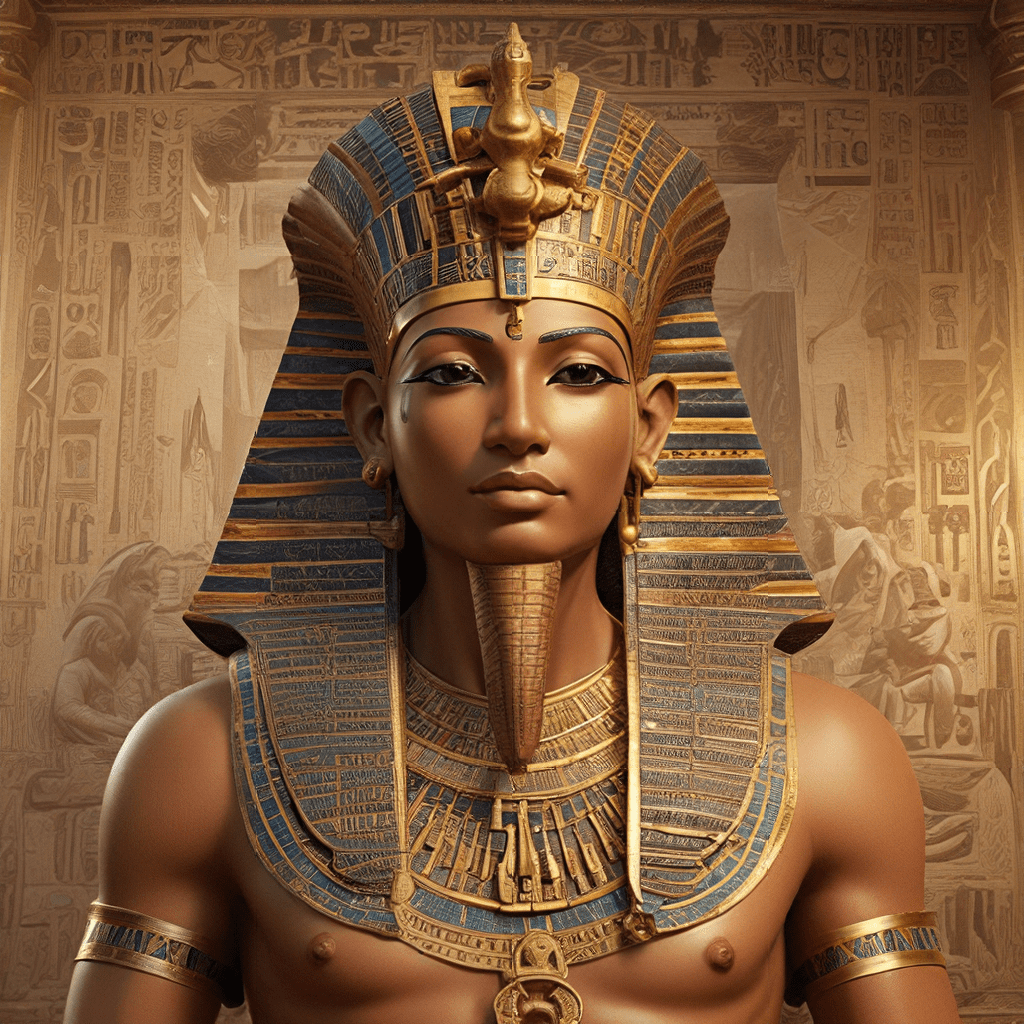
Ptah: The Creator God
In the ancient Egyptian pantheon, Ptah held a prominent position as the creator god, revered for his role in bringing the world into existence. Ptah was the patron deity of the city of Memphis, the ancient capital of Egypt, and his influence extended far beyond the realm of creation. He was also considered the master of craftsmanship, the divine architect who shaped the world and its inhabitants.
The Mythical Origins of Ptah
The origins of Ptah are steeped in myth and legend. Accounts suggest he emerged from the primordial waters of Nun, the embodiment of the infinite and formless abyss. Some narratives depict him as self-created, arising from the chaos that existed before the cosmos. His name, “Ptah,” is believed to be derived from the Egyptian word for “opener,” reflecting his role as the one who initiated the process of creation, opening the way for the emergence of the universe.
Ptah as the Architect of the World
Ptah’s creative power was not confined to simply bringing the world into existence. He was also seen as the architect, the divine craftsman who meticulously designed and shaped the cosmos. He was credited with creating the earth, the sky, the sun, the moon, and all the stars. Ancient texts describe him as using his divine tools, a potter’s wheel and a chisel, to mold the world from the primordial clay of Nun.
Ptah’s Role in Creation
Ptah’s role in creation extended beyond the physical world. He was also believed to have created the gods themselves. He gave them form, and their powers. He was often depicted as holding a “was” scepter, symbolizing his ability to create and manifest thought into reality. His creative power was considered to be the foundation of all creation, a force that brought order and structure to the universe.
Ptah as the Master of Craftsmanship
Beyond his role as the creator, Ptah was also revered as the master of craftsmanship. He was the patron deity of artisans, sculptors, and metalworkers. His workshops were believed to be located in Memphis, where he bestowed his skills upon humans. Artists and craftspeople would seek his blessings, hoping to receive his divine inspiration and guidance.
Ptah’s Connection to Memphis
Ptah’s connection to Memphis was deep and profound. His main temple, the “Great White Wall,” stood within the city, and he was considered the protector and guardian of the pharaohs who ruled from Memphis. The city’s name, “Mn-nfr,” meant “the good place,” a testament to Ptah’s beneficence and the prosperity he bestowed upon the city.
The Symbolism of Ptah
Ptah was often depicted as a bearded man, representing his wisdom and maturity. He was sometimes shown holding a “was” scepter, a symbol of his creative power. Another important symbol associated with him was the “djed,” a pillar representing stability and strength. The “djed” was thought to symbolize Ptah’s role as the foundation of creation, on which all else rested.
Ptah’s Relationship with Other Gods
Ptah’s relationship with other gods was complex and multifaceted. He was often depicted alongside his wife, Sekhmet, the goddess of war and healing. Together they were seen as the creative force behind the world, with Ptah representing the intellect and Sekhmet representing the power of the divine. He was also associated with the god Amun, who later became the supreme deity of Egypt. The two gods were believed to share a common origin, and their powers were seen as complementary, with Amun representing the hidden forces of creation and Ptah manifesting them in the physical world.
Ptah in Egyptian Art and Literature
Ptah’s presence is evident throughout Egyptian art and literature. He is depicted in numerous paintings, sculptures, and reliefs. His image adorns temple walls and tombs, a testament to his enduring importance. Ancient texts refer to him as the “Lord of Truth,” the “Maker of All Things,” and the “Master of Craftsmanship” His name appears in hymns and prayers, and his stories were passed down through generations.
Ptah’s Legacy and Influence
Despite the rise of other gods, Ptah remained a central figure in the Egyptian pantheon throughout the ages. His legacy as the creator and architect of the world continued to inspire artists and thinkers. He was associated with both physical and spiritual creation, a testament to the depth and complexity of his power. Ptah’s influence can be seen in the artistic creations, the architectural wonders, and the philosophical beliefs of ancient Egypt.