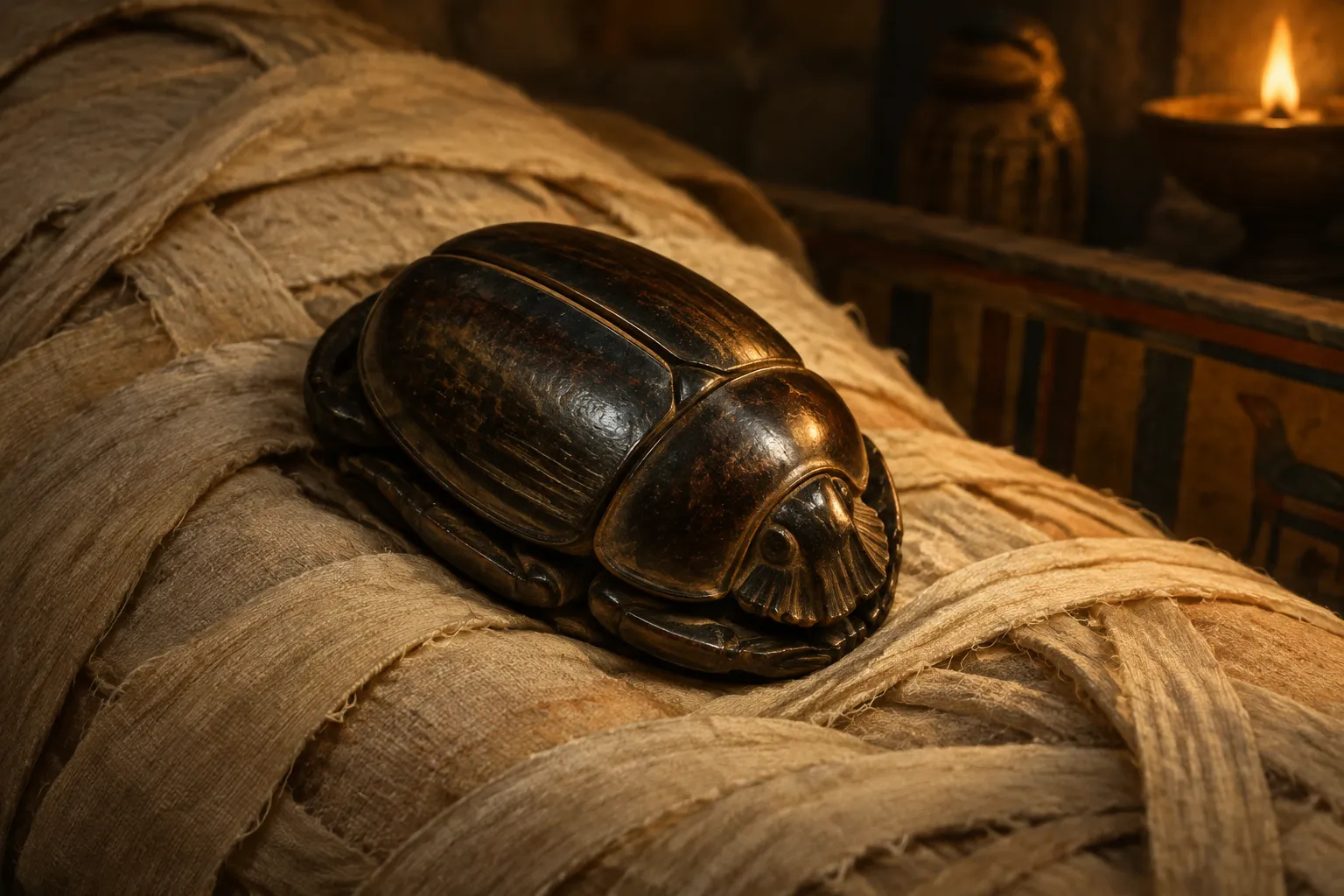
The witness you most needed to trust was already inside you. In Egyptian funerary tradition, the heart could speak against its owner at judgment. A protective text known as Book of the Dead spell 30B addressed that danger directly. As LACMA explains in its heart scarab record, the spell sought to prevent the heart from opposing the deceased before Osiris.
That is a more unsettling premise than a simple charm for good luck. The danger was not merely an enemy encountered after death, but a part of oneself. Why should the heart need instructions? And why give those instructions the body of a beetle?
Three surviving amulets help answer those questions. They also impose useful limits: these are Egyptian objects from different periods, not illustrations of one unchanging belief shared identically throughout Egyptian history.
1. The heart as a potentially dangerous witness
For the religious setting summarized by LACMA’s curatorial notes, the heart contained memory, thought, and moral values. It was therefore more than an organ sustaining the body. At judgment, it could give an unfavorable account of the person whose life it had accompanied.
The distinction matters. Calling the heart a witness is not simply a modern metaphor imposed on the evidence. In the inscription translated by the Walters Art Museum, its owner explicitly asks the heart not to testify against him or contradict him in court.
One way to understand the resulting anxiety is as a problem of divided identity. The deceased speaks as an individual, yet must appeal to something within that individual as though it could act independently. This is an interpretation of the spell’s dramatic structure, rather than proof that Egyptians held one systematic theory of the self.
For a reader, the crucial shift is from asking what a scarab represented to asking what this particular scarab was meant to accomplish. Its purpose becomes clearer when the imagined courtroom, rather than the beetle alone, is placed at the center.
2. A beetle carrying instructions
According to LACMA’s account of scarab symbolism, the insect evoked regeneration through its association with Khepri and the sun’s daily movement. Large heart scarabs could be placed at the neck or inside mummy wrappings. Their flat bases commonly carried spell 30B.
The amulet therefore joined a hopeful image with a targeted verbal defense. Rebirth was desirable, but so was protection against an adverse declaration. These functions should not be collapsed into the vague statement that every scarab simply meant good fortune.
It is useful to think of the object as an instruction given durable form. That is an explanatory comparison, not an ancient description. It draws attention to the relationship between shape and language: the beetle supplied a recognizable image of renewal, while the inscription addressed a particular obstacle.
Another funerary text tackled a different problem: the shabti spell’s provision for work in the afterlife. Keeping those purposes separate helps us see funerary equipment as a collection of specific responses, rather than one interchangeable category of magical objects.
3. An early scarab with a human face
A fragment in the Metropolitan Museum of Art complicates any expectation of a standardized beetle. Its insect head is replaced by a human face. The museum dates it to approximately 1802–1550 BCE, spanning its Middle Kingdom–Second Intermediate Period classification, and identifies its six horizontal lines as a version of spell 30B.
There is another small but striking detail: the bird hieroglyphs lack legs. The Met associates this writing practice with Dynasty 13 through early Dynasty 18. Its record identifies the object’s origin only as Egypt; it supplies no particular excavation locality.
Those limits deserve to remain visible. Without a documented findspot, we should not assign this fragment to a named cemetery or reconstruct its owner’s burial. Nor does its unusual face establish what all heart scarabs looked like.
The fragment offers a better lesson than a tidy origin story. A surviving object can securely demonstrate a particular combination of form and text without revealing every circumstance of its manufacture or use. Its missing context is part of the evidence we must work with, not an invitation to invent a scene.
4. Pa-en-Ptah asks his heart for loyalty
A later example makes the appeal personal. The Walters scarab belonging to Pa-en-Ptah dates to 1070–736 BCE, in the Third Intermediate Period. It is polished black-brown serpentine, with a vertically arranged inscription underneath. Its owner is identified as the head of a beverages depot.
In the museum’s translation, he addresses the heart received from his mother and associated with the successive stages of his life. He asks it not to oppose him before the court or the keeper of the balance. The appeal also concerns his reputation among the divine judges and asks the heart not to utter falsehoods.
Read closely, this is not a request to discard the heart as an unwanted burden. Pa-en-Ptah needs its cooperation. The emotional force, for a modern reader, lies in that dependence: the same intimate companion that helps constitute the person might also endanger him.
That reading should remain distinct from a reconstructed biography. His title and name personalize the amulet, but they do not tell us whether he feared a particular accusation. The inscription supplies a protective religious voice, not a confession preserved for us to diagnose.
5. Protection is not the same as permission to deceive
Was the spell a way to cheat judgment? The question is understandable, but its wording needs care. Both the Met’s description of the early fragment and the Walters translation frame the danger partly in terms of lies or hostile testimony. Opposition and false accusation are not necessarily identical to truthful disclosure.
The cautious conclusion is narrower than either accusation or apology: spell 30B sought favorable treatment from the heart. These objects alone cannot tell us how every owner reconciled that protection with moral accountability.
They also preserve variation rather than perfect uniformity: a human-faced fragment with horizontal writing and a later named owner’s scarab with vertical writing. Similar protective concerns could take different material forms across centuries.
The lasting reader payoff is this distinction between a symbol and an action. A heart scarab was not merely a beetle associated with life. Through its inscription, it intervened in an imagined encounter where identity, reputation, and survival were at stake. Its most intimate request was also its most urgent: let the heart remain an ally.
Sources and further reading
- The Metropolitan Museum of Art: Fragment of a Human-Headed Heart Scarab — early form, dating, and inscription.
- The Walters Art Museum: Heart Scarab — Pa-en-Ptah’s amulet and translated text.
- Los Angeles County Museum of Art: Heart Scarab — symbolism, placement, and protective purpose.


